
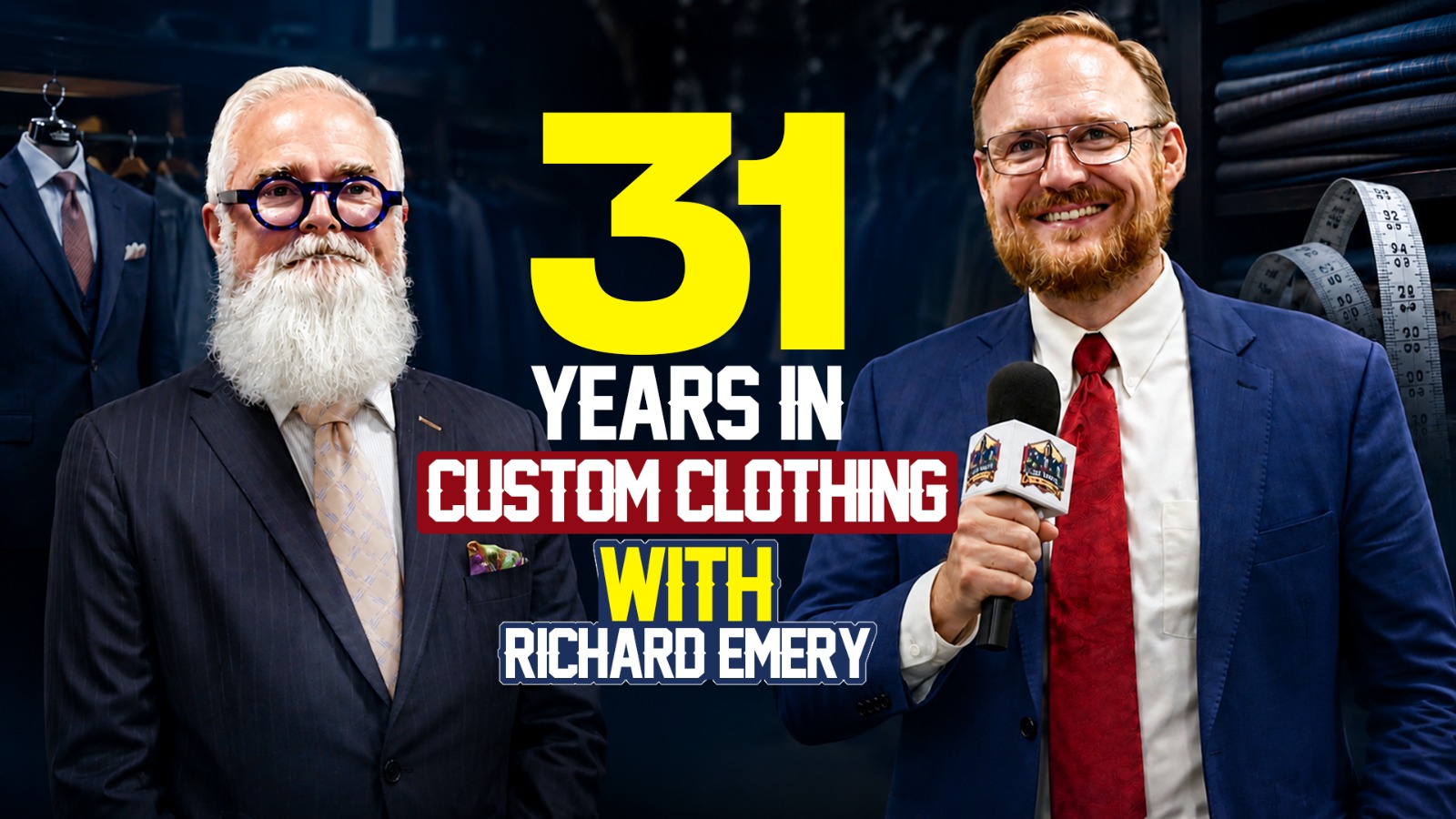
31 Years in Custom Clothing with Richard Emery
I talk with Richard Emery to discuss a career that has lasted more than 31 years now working with Tom James Company in Charleston. Richard has built his business around selling clothing to clients at their offices or homes. Our conversation covers how he entered the business, the changes he has seen in men’s clothing, the role of fit in professional dress, and the habits that have helped him stay in business for more than three decades. We also talk about adapting to technology, doing work that feels uncomfortable, and understanding how clothing affects a first impression.
Richard did not know what to expect when he entered the clothing business. He applied for the job while living in Florida and understood that he would be selling clothing to business professionals. It was not door-to-door sales in the traditional sense. Instead, he would travel from office to office and meet customers where they worked. The early years were difficult because he faced competition, but he found a market among people who wanted to buy clothing without spending time shopping in a store.
Richard has not spent his entire career with Tom James in the Charleston office. He was born in London and lived near London for more than 20 years before eventually making his way to West Virginia. He jokes that he tells people he is from Mingo County, even though his accent gives away a different background
During his career, Richard has watched men’s fashion move through several cycles. When he started, pleated pants, wider cuts, and jackets with broad shoulders were common. Men’s clothing has since shifted toward slimmer pants and two-button jackets. The way people dress for work has also changed.
Richard views COVID as a dividing point for the clothing business. Before the pandemic, more professionals worked from offices and had reasons to dress for a workplace each day. Remote work, Zoom meetings, and changes in workplace culture have made casual clothing more common. At the same time, there are still situations where people want or need to dress in a suit. Court appearances, business meetings, and other professional settings continue to create a need for formal clothing.
For someone building a professional wardrobe, Richard recommends starting with four types of suits: a solid navy suit, a solid charcoal suit, a navy pinstripe, and a charcoal pinstripe. He considers those the cornerstones of a man’s wardrobe because they provide options for a range of business and formal situations.
The biggest difference between a suit that looks right and one that does not is fit. A standard retail size is designed to fit a general body type. A custom suit is made for one person. Richard points out that custom clothing also allows choices such as functional buttons, lining, and other details, but he keeps returning to fit as the most important part.
That focus on fit is tied to the Tom James business model. Richard goes to the customer rather than asking the customer to come to him. He can visit a home or office, take measurements, review fabric swatches, and help plan a wardrobe. The company offers more than suits. Customers can purchase tuxedos, casual clothing, jeans, shoes, socks, and other items through the same process.
Richard does not travel with racks of finished clothing. He carries fabric swatches and uses an iPad to show customers their options. Most custom pieces are produced after the measurements and selections are completed. He identifies the bag he uses to carry his swatches as one of the best investments he has made because it is part of the basic system he uses to conduct business with clients.
The conversation also turns toward lessons that apply beyond the clothing industry. When I ask Richard about wasted time, he points to time spent driving. Because his business requires travel to customers, time behind the windshield can reduce the amount of ground he can cover during the day. Finding ways to serve more people with less travel can improve productivity.
One of Richard’s strongest principles for entrepreneurs is that successful people have to do tasks that others avoid. For him, one example is making phone calls. Picking up the phone and contacting people can be uncomfortable, but avoiding that work does not build a business. We discuss the idea that entrepreneurs have to become comfortable doing things that make them uncomfortable.
That lesson continues even after 31 years. Richard still works on his measuring skills and his ability to use the phone. Experience does not remove the need to keep practicing the basic skills that drive the business.
Technology has required another type of adjustment. Richard began his career in a time when information was written on paper. Today, much of the sales process involves an iPad and other technology. He admits that this transition has been difficult for him because he still trusts writing information down. Even so, the business has changed, and adapting to new tools has become part of continuing to work in the industry.
Richard sums up his approach to clothing with a principle he has shared with customers for years: people get one chance to make a first impression. Clothing does not replace ability or experience, but presentation sends a message before a conversation begins. His closing belief, that “a naked man has no influence on society,” puts that idea into one sentence.
My conversation with Richard Emery shows how a career can be built through consistency, service, and a willingness to adjust. Fashion has changed, workplaces have changed, and technology has changed, but several parts of his business have remained the same. Fit matters. Relationships matter. Customers value convenience. Business owners have to do work they would rather avoid. After more than three decades in the same industry, Richard’s experience shows that staying in business requires learning what customers value, practicing the skills that produce results, and continuing to adapt when the way business is done changes.