
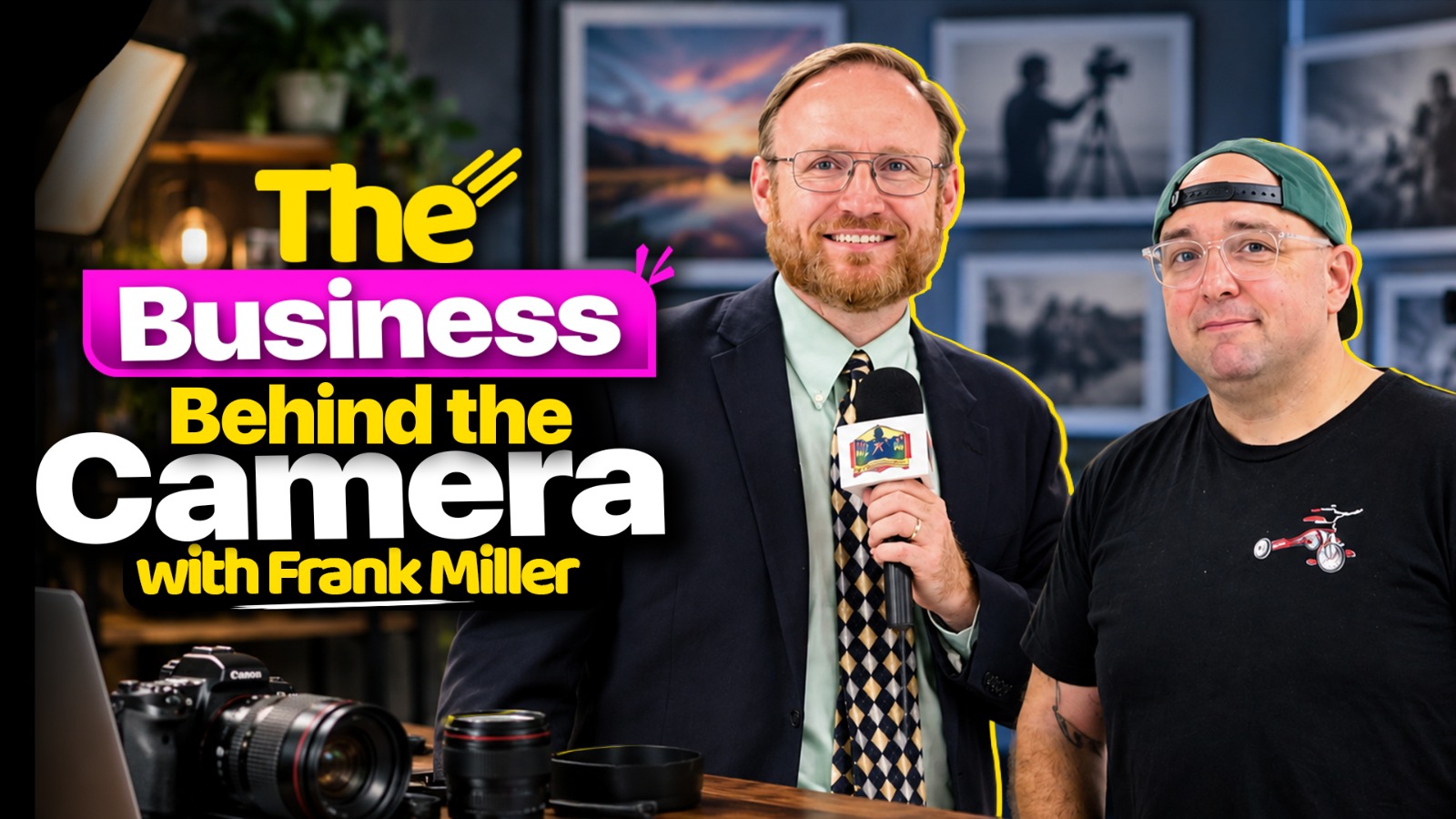
The Business Behind the Camera with Frank Miller
My conversation with Frank Miller explores how a photography and filmmaking business can change as the owner learns what the market needs. Frank entered the business expecting most of his work to come from families, weddings, and other consumer clients. Instead, he found himself moving into business-to-business and commercial work. That shift gave him a chance to build relationships with clients over time, create contracts that provide repeat work, and reduce the pressure of filling his schedule from scratch each month.
Frank’s experience also shows how easy it is for a business owner to spend money for the wrong reasons. Early in his career, he bought equipment he did not need because he felt pressure to keep up with other photographers and filmmakers. Over time, he stopped viewing other people in his field as competitors. He came to see them as people with their own styles, voices, and approaches. That allowed him to build relationships with others in the industry instead of measuring his business against theirs.
Marketing created another lesson. Frank tried using social media to bring in work but realized that approach did not fit how he wanted to build his business. He needed another way to meet clients and develop relationships. Networking became that solution. He began attending events and joining groups where he could meet people face to face. His experience reinforces something I have seen in business as well. The rooms you enter matter, but the people in those rooms matter just as much.
We also discuss the value of hiring a photographer at a time when almost everyone carries a camera in a phone. Technology has removed much of the barrier that once separated photographers from consumers. Frank believes the difference comes from experience and the ability to understand light, composition, and the moment being captured. A camera records what is in front of it, but the person behind the camera still decides what matters and how it should be presented. That becomes even more important at events, where someone trying to manage the event and document it at the same time may struggle to do both.
Artificial intelligence adds another challenge. Frank uses AI for parts of the back end of his business but does not depend on it to create work for clients. He has seen customers choose AI because they believe they can produce something themselves. At the same time, he does not believe AI removes the need for photographers and filmmakers. His focus remains on the judgment and experience needed to recognize moments worth capturing. We agree that this matters most when documenting real people and events. People want to see what happened, not a manufactured version of it. That may place more value on authenticity as AI-generated images become more common.
Frank has also learned where his own time provides the most value. The best money he has spent has gone toward hiring and training people who can share the workload. Instead of trying to handle every part of the business himself, he can teach others and create a team. On the other hand, he considers doing his own bookkeeping one of his biggest wastes of time. Both examples point toward the same lesson: business owners have to recognize what they should handle themselves and what should be given to someone else.
Self-discipline is another part of that process. Frank names it as a skill every entrepreneur needs and also admits it remains something he works on himself. For him, that can mean resisting another camera purchase. For any entrepreneur, it can mean avoiding distractions and staying focused on the work that needs to be completed.
The main lesson I take from Frank’s experience is that building a business requires more than skill at the service you provide. It requires relationships, discipline, decisions about where to spend money, and the willingness to change your approach when something is not working. Frank has moved from chasing equipment and worrying about competition toward building relationships, developing a team, and focusing on the work that makes his business useful. His guiding principle is to strive for perfection with the understanding that even when he falls short, the effort can still produce excellence.